The biggest misconception in many engineering selections is confusing aerogel blankets with aerogel coatings. Obviously, high-temperature steam straight pipes blindly use coatings that cause the insulation layer to be too thick and cost double; Clearly, storage tanks have large, curved surfaces and irregularly shaped structures, but hard-laying aerogel blankets cause many gaps, high rework rates, and later water leakage and temperature drops.
Although both are called aerogels, their applicable temperature ranges, construction methods, optimal application areas, and overall cost logic are completely different.
In short, the mainstream optimal engineering pairing:
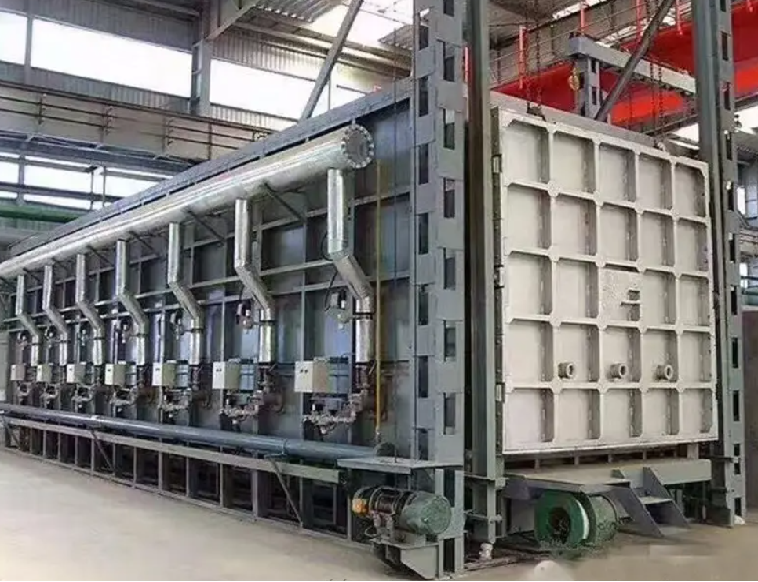
High-temperature process pipelines, long-distance steam straight pipes→ aerogel blankets
Aerogel coatings are used for medium and low-temperature storage tanks, equipment surfaces, and irregularly shaped components→
This article explains from three dimensions: construction implementation, working condition adaptation, and full-cycle cost, helping you choose the right materials, avoid over-budget, and avoid rework pitfalls.
First, distinguish the core attributes: The two are fundamentally different types of insulation systems
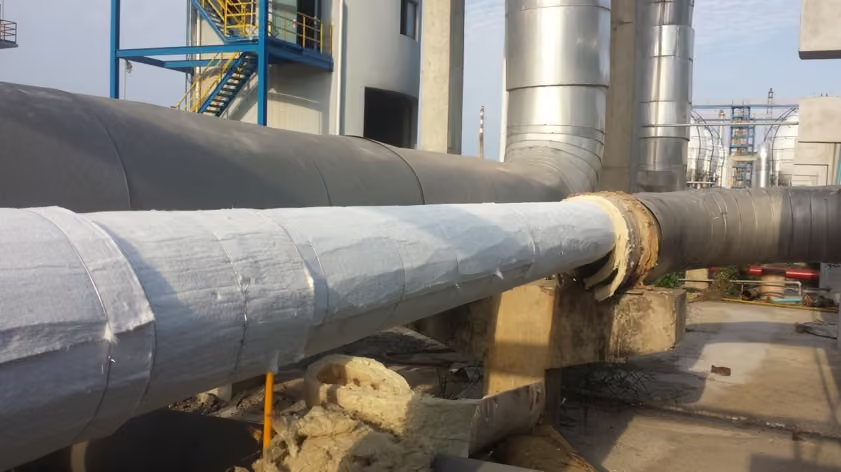
Aerogel felt: Main material for high-temperature flexible insulation, specialized for pipelines
Aerogel blankets are high-load aerogel + fiberglass composite formed membranes, with aerogel as the core insulation body, stable pore structure, and extremely strong high-temperature resistance.
Core parameter advantages: Thermal conductivity at room temperature 0.018–0.023 W/(m·K), long-term temperature resistance up to 650°C, almost no degradation under high-temperature conditions, strong resistance to thermal shock and pipeline thermal expansion and contraction.
Its product positioning is the main insulation layer for industrial high-temperature pipelines. SANAT Aerogel Insulation LTD, Guangdong, CN has been deeply engaged in the research, development, and production of aerogel insulation materials for many years. Its SNTS series high-temperature aerogel blankets are specially customized for industrial high-temperature pipeline conditions, relying on a stable nanopore structure, perfectly meeting the long-term insulation needs of various long-distance high-temperature steam straight pipes and process heat pipelines, making them the preferred main material for industrial high-temperature pipeline insulation
Aerogel coatings: insulation for medium and low-temperature flexible surfaces, specially designed for tank bodies
Aerogel coatings use aerogel powder as fillers, dispersed within the coating system, and achieve dual effects of insulation and anti-corrosion through overall film formation. They are not pure aerogel insulation main materials.
Core parameters: thermal conductivity 0.035–0.045 W/(m·K), significantly higher than aerogel blankets, suitable for operating conditions in the -40°C~120°C to low temperature range
Its product positioning is medium and low-temperature equipment, storage tanks, and integrated insulation and sealing layers for complex and irregular structures. SANAT Aerogel Insulation LTD, Guangdong, CN independently develops and produces SNTG industrial aerogel coatings, precisely matching -40°C~120°C medium and low temperature conditions, balancing both thermal insulation and anti-corrosion protection, perfectly solving the construction challenges of tank bodies and special-shaped equipment
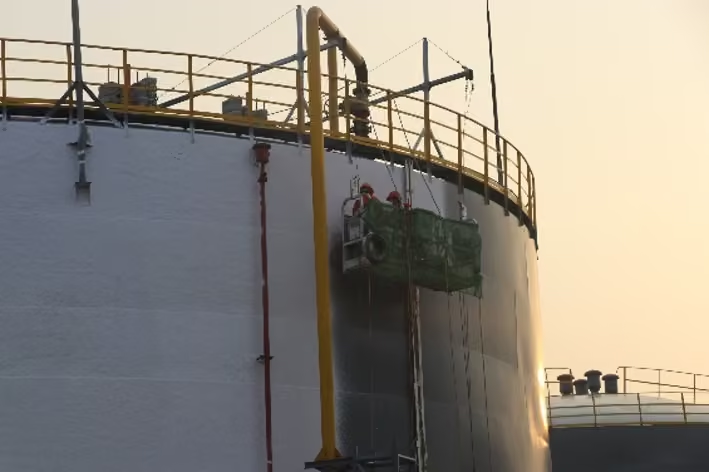
Precise Matching of Working Conditions: Why Are High-Temperature Straight Pipes More Suitable for Felt, and Is Coating Preferred for Tank Bodies?
Aerogel Blanket: Specialized for [Long-distance Direct Pipes at High and Low Temperatures]
In petrochemical, thermal, and chemical projects, high-temperature steam pipelines and process heat pipelines have three strict requirements: high temperature resistance, low heat loss, long-term stability, and resistance to settling and cracking
Compatibility advantages of aerogel blankets that fully fit pipeline working conditions:
- Strong high-temperature stability: In high-temperature environments of 300°C–600°C, it does not chalke or drop sharply, far surpassing rock wool and aluminum silicate, and also outperforms aerogel coatings in high-temperature resistance
- Thin layer high insulation: Same insulation effect, thickness only 1/2–1/3 of traditional insulation, easy installation even in narrow pipeline spaces without increasing pipeline load
- Good pipeline compatibility: The membrane is highly flexible, able to expand and contract with the pipeline heat, preventing insulation cracking, detachment, and heat leakage through gaps
- High construction efficiency: Straight pipes cover large areas, simple cutting, standardized lap joints, standardized construction, controllable schedule, and high acceptance pass rate
- Absolute pitfall: High-temperature straight pipes must not use aerogel coatings on large areas. To achieve the same insulation effect as felt, the coating requires an ultra-thick coating, which is not only difficult to apply and has a long drying and curing period, but also significantly exceeds the overall cost of aerogel felt, and lacks long-term stability at high temperatures
Aerogel Coatings: Specialized for [Medium and Low Temperature Tanks + Special-shaped Equipment]
The biggest construction pain points for storage tanks, reactors, large equipment, and pipelines: large, curved surfaces, numerous corners, dense flange bolts, and complex structures
If aerogel blankets are forcibly laid, three major problems will occur: fragmented cutting, many gaps in joints, poor adhesion of curved surfaces, rainwater and moisture seeping in, insulation failure, and condensation and temperature drop.
Aerogel coatings have maximized their advantages in tank construction, making them the optimal solution for medium and low-temperature tanks:
- No dead corners full coverage: Can be brushed, sprayed, or rolled. Whether it’s large curved surfaces on the tank wall, round top curves, manholes, flanges, or bolt dead corners, it forms a film with zero seams, completely solving the problems of tank heat leakage and water seepage
- Perfectly adapted to medium and low temperature conditions: diesel, gasoline, LPG, chemical media storage tanks (-40°C~120°C), with perfectly matched temperature ranges, long-term weather resistance, sun exposure, and dry and wet cycle resistance
- Insulation + anti-corrosion integration: Tanks operate outdoors in many environments, and the coating forms a dense film, providing both heat and cold insulation while blocking air corrosion, eliminating additional anti-corrosion steps
- Lower tank construction costs: no need for extensive cutting, no complex overlaps, no worries about gap rework, lowering labor costs for large-area tank construction, and improving overall appearance and acceptance results
- Clear division of labor: main insulation of medium and low-temperature tanks, full coverage of special-shaped equipment → priority for aerogel coatings; Local high-temperature piping and short sections of the tank body→ partial reinforcement with aerogel blankets only
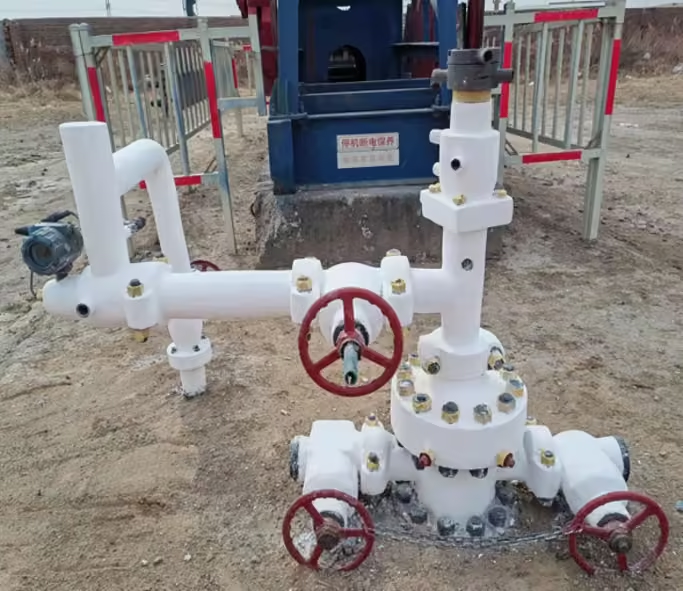
Comparison of Construction Implementation Depths: Understand on-site differences and avoid choosing the wrong materials
| Contrast dimensions | Aerogel Blanket (Straight Pipeline for High and Low Temperatures) | Aerogel coatings (medium and low temperature tanks/equipment) |
| Applicable temperature | -200°C~650°C (main high-temperature power) | -40°C~120°C (optimal for medium and low temperatures) |
| The best construction location | Long-distance high and low temperature steam straight pipes, process heat pipelines | Oil storage tanks, chemical storage tanks, equipment surfaces, and irregular joints |
| Construction method | Cutting, wrapping, bundling, and external protection sealing | Spraying/brushing, the entire film forms with no seams |
| Structural compatibility | Straight pipes are optimal, but complex surfaces and dead corners are poorly adapted | Curved surfaces, irregular shapes, and dead corners are fully covered, offering excellent adaptability |
| Frequently Asked Questions | Irregular areas have many gaps and high cutting wear | Insufficient insulation under high-temperature conditions, long thick coating periods |
| Core advantages | High temperature, low thermal conductivity, stable performance, and ultimate energy-saving effect for pipelines | The tank has no dead corners, integrated anti-corrosion and insulation, and a low rate of rework during construction |
Full-cycle cost breakdown: Don’t just look at unit price, look at “working condition cost-effectiveness”
High-temperature pipelines: aerogel blankets have lower overall costs
Aerogel blankets are more expensive than coatings but have double insulation efficiency. For high-temperature pipelines to meet insulation standards, coatings need several times the thickness, consumables, labor, and construction time are all doubled, with overall costs far exceeding those of felt.
Moreover, felt materials are heat-resistant and have a long lifespan, allowing pipelines to operate year-round without frequent maintenance or replacement, resulting in higher long-term energy savings.
Medium and low temperature tanks: aerogel coatings offer outstanding cost-performance ratio
If the tank is entirely covered with aerogel felt, cutting losses, gap treatment, and labor costs are extremely high, and there are also risks of water leakage and heat leakage, resulting in high maintenance costs in the later stages.
Aerogel coatings are formed in one step, offer good sealing, weather resistance, and corrosion resistance, suitable for tank open-air and dry-wet cycle conditions. For coatings used in medium and low-temperature tanks, they are both cost-effective and worry-free solutions
Conclusion and summary
Aerogel blankets are not a cure-all, and aerogel coatings are not universal substitutes.
For high-temperature pipelines, judge by performance and choose felt; For medium and low-temperature tanks, consider construction and sealing, and choose the coating. Precisely grasping the temperature range and construction area is the key to avoiding pitfalls such as high prices, low efficiency, and rework rectification, truly achieving insulation standards, controllable costs, and long-term peace of mind.