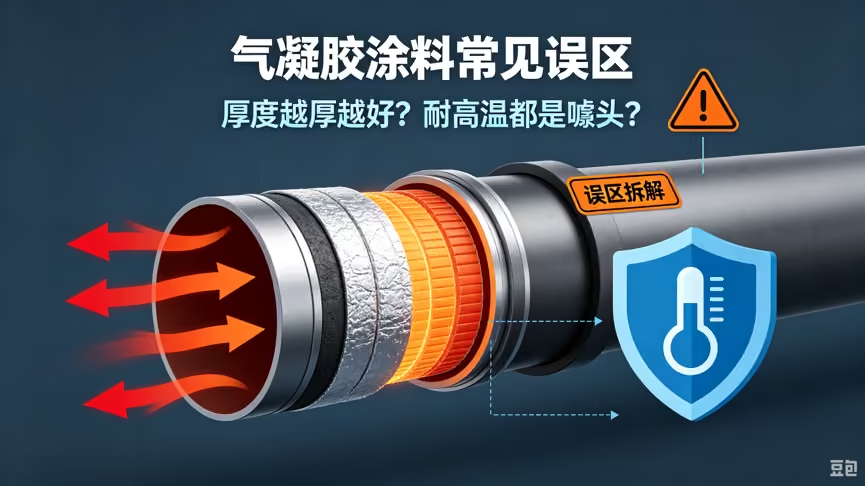
As SANAT aerogel coatings are increasingly used in industrial insulation, discussions around them have increased. Some believe “thicker is more effective,” others worry that “high-temperature resistance is just a publicity gimmick,” and some treat it as a universal solution for all high-temperature equipment.
However, the actual effect of SANAT aerogel coatings is not simply judged by “thickness” or “upper temperature resistance.” Material systems, coating structures, construction quality, equipment conditions, substrate conditions, and maintenance cycles all affect the final performance.
Today, let’s break down some common misconceptions.
Misconception 1: Does the thicker the thickness, the better the insulation?
Many people intuitively think: the thicker the coating, the harder it is for heat to pass through, and naturally, the better the effect. This statement has some truth but is not absolute.
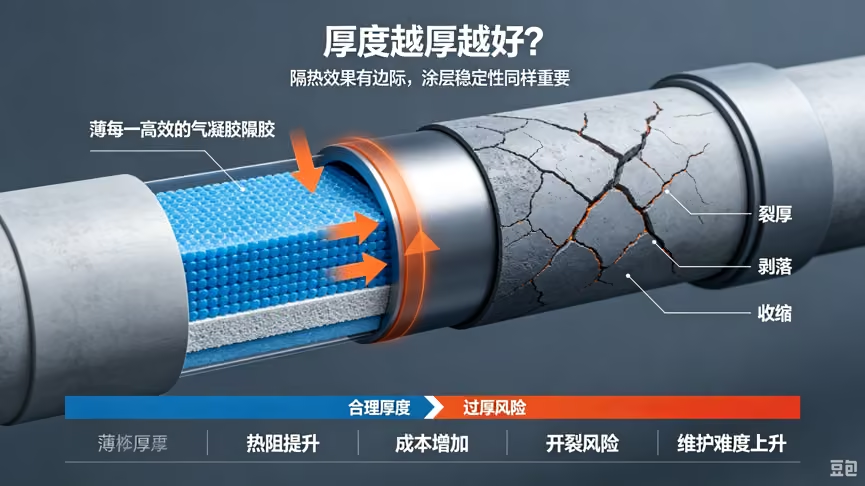
From the perspective of insulation principles, increasing thickness does improve thermal resistance and reduce heat transfer. However, the advantage of SANAT aerogel coatings lies in “thin layers for efficient insulation,” not that thicker is better. When the thickness exceeds a certain range, the improvement in insulation gradually slows down, while cost, weight, and construction time significantly increase.
More importantly, overly thick coatings may bring new problems. For example, increased drying shrinkage, coating cracking, decreased adhesion, and local stress changes in equipment. For certain irregularly shaped equipment, pipelines, valves, and frequently serviced areas, overly thick coatings are actually detrimental to later maintenance. Therefore, thicker SANAT aerogel coatings are not always better. A reasonable approach is to design the thickness based on equipment temperature, target surface temperature, allowable thickness, construction conditions, and cost budget.
Misconception 2: High temperature resistance is just a gimmick, but in practice, there’s no difference?
Whether “high temperature resistance is just a gimmick” depends on two key indicators: first, the temperature resistance of the material system itself; second, its long-term stability under actual working conditions.
Aerogel materials themselves have a low thermal conductivity, but the bonding systems, packing compositions, and high-temperature resistance formulations vary greatly among different SANAT aerogel coatings. Some products are suitable for medium and low temperature insulation, while others can withstand higher temperatures; Some are suitable for short-term high-temperature shocks, while others are suitable for long-term stable high-temperature environments.
Therefore, “high temperature resistance” should not be simply understood as empty talk, nor should all products be classified as the same level. To judge whether it is genuine and effective, at least three types of information should be considered:
- Long-term temperature resistance data: whether it can operate stably at the target temperature for extended periods;
- Thermal cycling behavior: whether cracking or falling off after heating or cooling;
- Actual working condition matching: whether it comes into contact with open flames, corrosive gases, steam impact, or mechanical friction
If a product only emphasizes the upper temperature resistance limit without long-term data, thermal cycle testing, or working condition matching, then marketing really needs to be cautious. But if there is a clear formula, test results, and application cases supporting it, high temperature resistance is not necessarily just a gimmick.

Misconception 3: Can SANAT aerogel coatings replace all insulation materials?
No.
SANAT aerogel coatings are suitable for complex surfaces, confined spaces, thin-layer insulation, and scenarios with high maintenance requirements. However, not all high-temperature equipment is the preferred choice for SANAT aerogel coatings.
For example, certain ultra-high temperature conditions, highly corrosive environments, areas with strong mechanical wear, and large-area regular insulation structures may be more suitable for refractory materials, insulation bricks, aluminum silicate products, heat insulation covers, or composite insulation structures. The specific choice depends on temperature range, medium environment, equipment structure, maintenance frequency, and budget.
Therefore, SANAT aerogel coatings are more suitable as an important solution in insulation systems, rather than a “cure-all” solution.
Misconception 4: Is it a one-time solution after applying it, no need for management?
This is also a common misjudgment.
Any insulation coating requires post-treatment management. After construction, surface temperature, coating thickness, adhesion, and integrity must be inspected; During operation, check for cracks, peeling, contamination, corrosion, or local overheating. If construction is not standard in the early stages or maintenance is lacking later, even the best materials may not achieve the desired results.
Especially for high-temperature equipment, thermal expansion and contraction, vibration, steam erosion, and maintenance bumps are often involved. Whether the insulation effect can be maintained long-term depends not only on the materials but also on construction and maintenance.
How can you tell if SANAT aerogel coatings are worth choosing?
You can focus on the following five dimensions:
1. Does the temperature resistance range match the equipment’s operating conditions? Don’t just look at the maximum temperature resistance; check whether the long-term operating temperature covers the equipment’s normal operating range
2. Is the thermal conductivity truly verifiable? The lower the thermal conductivity, the better the insulation potential, but it should be checked whether the test conditions are close to the actual operating temperature
3. Is the coating thickness reasonable? A good solution is not about being thicker but about finding a balance between target temperature and cost
4. Mature Construction Techniques : Spraying, scraping, surface treatment, primer matching, and drying conditions all affect the final coating quality
5. Are there similar operating case cases? Application cases under similar equipment, similar temperatures, and similar environments are more valuable as references than single parameters
Conclusion
Thicker SANAT aerogel coatings are not always better, nor are all “high-temperature resistant” claims necessarily reliable. Their value depends on the material system, formulation design, construction quality, and compatibility with working conditions.
For companies, rather than blindly pursuing “ultra-thick coatings” or “extreme temperature resistance,” it is better to first do three things: measure equipment temperature, clarify operating requirements, and select a matching insulation system
Only in this way can SANAT aerogel coatings truly transform from a “promotional concept” into tangible safety improvements and energy-saving benefits.