Friends working in building insulation or industrial equipment energy saving have encountered this problem:
The insulation layer is very thick, but the insulation effect is still poor, and the problem of hot summer and cold winter has not improved.
Traditional insulation materials are heavy, prone to cracking, absorb moisture, and will age and peel off within a few years.
Construction procedures are complicated, with long schedules and persistently high maintenance costs afterward.
Trying to meet energy-saving standards but also worrying about occupying space and increasing load, caught in a dilemma.
For a long time, traditional materials such as ordinary insulation coatings, rock wool, and polyurethane have been the mainstream choices in the insulation industry. However, due to the shortcomings of the materials themselves, they have been unable to meet the four core requirements of being lightweight and lightweight, highly efficient, durable, and easy to install.
In recent years, the rapidly popular SANAT aerogel insulation coating, leveraging its core advantages of aerospace-grade new materials, has completely broken through the technical bottlenecks of traditional insulation, becoming the preferred solution for building exterior walls, industrial pipelines, high-temperature equipment, and old renovation projects.
Today, we’ll explain the core differences between SANAT aerogel coating and ordinary insulation coatings in the most straightforward and practical way, helping you avoid material selection pitfalls and precisely match your project needs.

01 Core Principles Different: Passive Stacking VS Active Heat Insulation
Many people think: the thicker the insulation layer, the better the heat insulation.
This is the biggest misconception and biggest shortcoming of traditional insulation materials.
Ordinary insulation coatings
Ordinary insulation coatings, mortar, putty, and other products have core principles based on physical stacking insulation. They rely on tiny pores inside the coating to lock in air and slow heat transfer but lack a highly efficient insulation core material.
This results in extremely limited thermal insulation capacity. To achieve standard insulation performance, the coating thickness must be continuously increased, generally requiring 3–5cm or even more.
Moreover, pores easily absorb water and moisture. Once water enters, the air layer is destroyed, causing insulation performance to plummet. This is the core reason why insulation fails after just a few years.
SANAT aerogel insulation coating
As a new generation of nano insulation material, Sinate aerogel itself is currently known to be a solid-state material with top-tier thermal insulation performance, derived from aerospace insulation technology.
SANAT aerogel coating uses nano SANAT aerogel particles as the core insulation medium, combined with special emulsions and functional fillers for modification. Relying on a nano three-dimensional mesh pore structure, it actively blocks the triple heat transfer paths of heat conduction, convection, and radiation.
Simply put ordinary coatings rely on “thickness to match the effect,” while Sainart aerogel coatings rely on “material to win performance.”
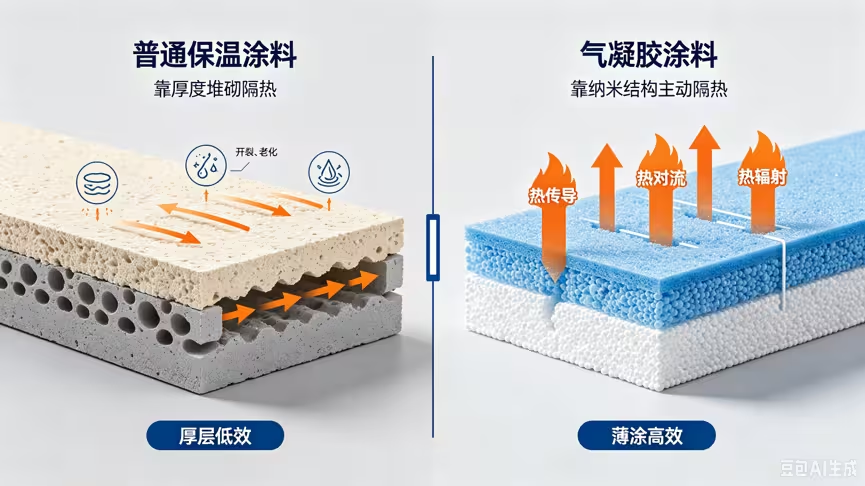
This is the most direct and disruptive industry gap between the two, and the core reason why engineering and renovation projects favor SANAT aerogel coatings.
1. Thickness difference: 1mm equals 10mm, extremely thin and lightweight
Ordinary insulation coatings require thick coatings, which take up a lot of space and increase the load on walls and equipment, making retrofitting old buildings and lightweight equipment highly constrained.
In contrast, SANAT aerogel coatings provide strong insulation even when applied thinly. With a conventional thickness of 1–3mm, the insulation effect rivals that of traditional insulation coatings of 10–30mm. It is lightweight and space-saving, perfectly suitable for various scenarios with limited space and load.
2. Temperature Tolerance Difference: Versatile adaptation to high and low temperatures
Ordinary insulation coatings have a narrow temperature resistance range, are prone to softening, chalking, and cracking in high-temperature environments, and are prone to brittle cracking in low-temperature environments. They can only meet the ambient temperature insulation needs of ordinary buildings and are completely unsuitable for industrial high-temperature equipment, pipelines, and storage tank scenarios.
SANAT aerogel coatings have an extremely wide temperature resistance range, tolerating extreme temperature differences of -50°C~600°C. They do not melt or peel off at high temperatures, nor crack at low temperatures. They not only solve the problem of summer exterior walls facing high temperatures from the west, but also meet the needs of industrial high-temperature equipment insulation and winter frost protection.
3. Stability gap: waterproof, weather-resistant, long-lasting
The biggest pain point of traditional insulation materials is fear of water and aging. Outdoor exposure to sunlight, rain, and humidity can cause the coating to absorb water, mold, hollow, and peel. Generally, it needs to be renovated and maintained every 3–5 years, with very high costs later.
SANAT aerogel coatings have excellent hydrophobic and waterproof, UV-resistant, weather-resistant, and anti-corrosion properties. The coating is dense and stable, does not absorb water or regress moisture, resists wind, sun, and acid and alkali corrosion, and has a service life of over 15 years, significantly reducing maintenance costs.
03 Construction and Cost: Short-term labor savings, long-term energy savings
Many people think Sainart aerogel coatings are more expensive, but after looking at the comprehensive cost comparison, you understand what true “cost reduction and efficiency improvement” really means.
Ordinary insulation coatings
✅ Low unit price per item
❌ Disadvantages are extremely obvious: many construction layers, large thickness, long construction period, and high labor costs; Heavy materials, high transportation and handling costs; Easily damaged and high rework rate; Renovation required every 3-5 years, with extremely high long-term maintenance costs; Poor insulation effect, high energy consumption for buildings and equipment.
SANAT aerogel insulation coating
✅ Extremely simple application: can be sprayed, rolled, or brushed directly, no complex primer is needed, thin coating is formed, significantly shortening construction periods and saving labor costs; The coating is thin and lightweight, does not increase the load on buildings or equipment, suitable for old renovations and lightweight construction scenarios
✅ Lower overall cost: long-lasting and durable after a single application, no need for frequent renovations; Excellent thermal insulation and energy-saving effects, saving enterprises and buildings a large amount of electricity and energy costs over the long term, with cost-effectiveness far exceeding traditional materials
✅ Wider compatibility: For irregularly shaped pipes, curved equipment, and complex exterior wall shapes, traditional insulation panels and thick coatings are difficult to install. SANAT Aerogel Coating can be seamlessly adhered without dead corners or seams, ensuring more complete insulation.
04 Precise differentiation of applicable scenarios, ensuring material selection without pitfalls.
Ordinary insulation coatings are suitable for:
Ordinary interior walls and conventional new building interior wall insulation, very low budget, and basic scenarios with low requirements for insulation performance and service life.
SANAT aerogel insulation coating is suitable for:
1. Construction field: exterior wall insulation and heat preservation, west-facing cooling on top floors, energy-saving renovations of old residential communities, energy-saving renovations of villas/factories.
2. Industrial sector: insulation and cooling of high-temperature pipelines, boilers, storage tanks, and machinery, as well as high-temperature treatment in workshops.
3. Special scenarios: cold chain storage insulation, outdoor equipment anti-corrosion insulation, insulation projects for acidic, alkali, and humid environments.
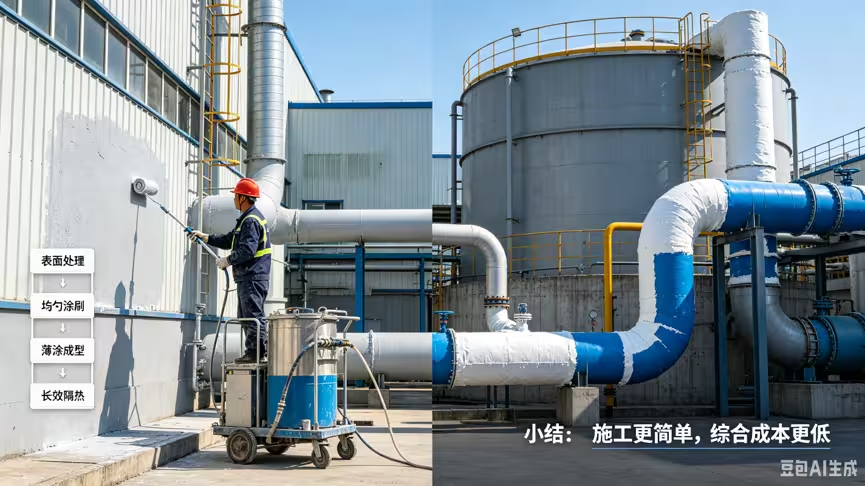
05 Summary: Why is Sinate aerogel considered the new benchmark in the insulation industry?
Traditional insulation coatings are “compromise insulation”relying on thickness to compensate for performance shortcomings, addressing symptoms but not root causes, resulting in many problems, short lifespans, and high long-term costs.
SANAT aerogel insulation coating is an “upgraded insulation” solution—breaking industry bottlenecks with new material technology, achieving truly efficient energy savings with thinner coatings, more stable performance, and longer lifespan.
With the continuous implementation of dual carbon policies, the upgrading of building energy-saving standards, and the surging demand for industrial energy conservation and cost reduction, traditional insulation materials that are bulky, easily damaged, and inefficient can no longer meet the demands of high-end projects and long-term energy saving.
The thin, efficient, weather-resistant, long-lasting, and easy-to-apply SANAT aerogel insulation coating is redefining new standards in the insulation industry and becoming the mainstream trend in the future energy-saving insulation field.
If you have projects such as building renovation, industrial equipment insulation, or energy-saving upgrades, and want to balance effectiveness, construction period, and long-term costs, SANAT aerogel coatings are definitely the most cost-effective and preferred choice.